For a Double Slit as the Slit Separation Is Increased What Happens to the Pattern
Diffraction
27 Double-Slit Diffraction
Learning Objectives
By the cease of this section, yous will exist able to:
- Describe the combined result of interference and diffraction with 2 slits, each with finite width
- Determine the relative intensities of interference fringes inside a diffraction pattern
- Identify missing orders, if whatsoever
When we studied interference in Young'south double-slit experiment, nosotros ignored the diffraction issue in each slit. We assumed that the slits were so narrow that on the screen you lot saw merely the interference of light from just two bespeak sources. If the slit is smaller than the wavelength, and so (Figure)(a) shows that there is but a spreading of light and no peaks or troughs on the screen. Therefore, information technology was reasonable to leave out the diffraction effect in that chapter. However, if you make the slit wider, (Figure)(b) and (c) evidence that you cannot ignore diffraction. In this section, we report the complications to the double-slit experiment that arise when you also need to take into account the diffraction effect of each slit.
To calculate the diffraction design for two (or any number of) slits, we need to generalize the method nosotros but used for a single slit. That is, across each slit, we place a uniform distribution of betoken sources that radiate Huygens wavelets, so nosotros sum the wavelets from all the slits. This gives the intensity at any point on the screen. Although the details of that adding can be complicated, the terminal issue is quite simple:
Two-Slit Diffraction Pattern
The diffraction pattern of two slits of width D that are separated by a distance d is the interference pattern of two point sources separated past d multiplied by the diffraction design of a slit of width D.
In other words, the locations of the interference fringes are given by the equation  , the same as when nosotros considered the slits to be indicate sources, merely the intensities of the fringes are now reduced past diffraction effects, according to (Effigy). [Note that in the chapter on interference, nosotros wrote and used the integer m to refer to interference fringes. (Figure) likewise uses 1000, but this time to refer to diffraction minima. If both equations are used simultaneously, it is good practice to use a unlike variable (such equally northward) for 1 of these integers in guild to keep them singled-out.]
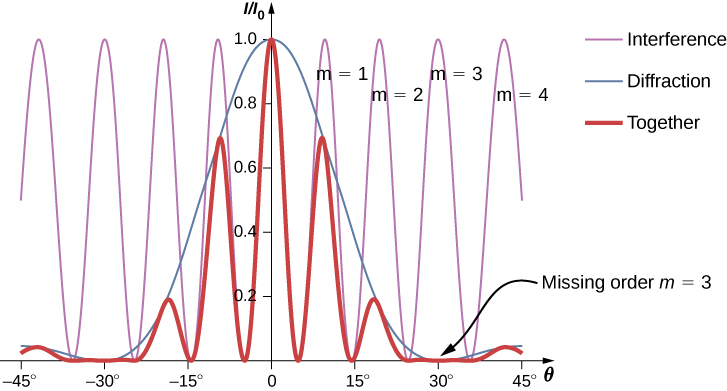
Interference and diffraction effects operate simultaneously and mostly produce minima at different angles. This gives rise to a complicated pattern on the screen, in which some of the maxima of interference from the two slits are missing if the maximum of the interference is in the same direction as the minimum of the diffraction. Nosotros refer to such a missing height as a missing order. Ane example of a diffraction pattern on the screen is shown in (Figure). The solid line with multiple peaks of diverse heights is the intensity observed on the screen. It is a production of the interference pattern of waves from separate slits and the diffraction of waves from inside one slit.
Diffraction from a double slit. The purple line with peaks of the same meridian are from the interference of the waves from ii slits; the blue line with one big hump in the middle is the diffraction of waves from within one slit; and the thick blood-red line is the production of the two, which is the blueprint observed on the screen. The plot shows the expected result for a slit width  and slit separation
  . The maximum of
  order for the interference is missing because the minimum of the diffraction occurs in the same direction.
Intensity of the Fringes(Figure) shows that the intensity of the fringe for  is zero, but what almost the other fringes? Calculate the intensity for the fringe at
  relative to
  the intensity of the central peak.
Strategy Determine the angle for the double-slit interference fringe, using the equation from Interference, then determine the relative intensity in that direction due to diffraction past using (Figure).
Solution From the chapter on interference, nosotros know that the bright interference fringes occur at , or

From (Figure),

Substituting from to a higher place,

For  ,
,  , and ,
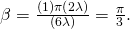
Then, the intensity is

Significance Note that this arroyo is relatively straightforward and gives a result that is nigh exactly the same as the more complicated assay using phasors to work out the intensity values of the double-slit interference (thin line in (Figure)). The phasor approach accounts for the downward slope in the diffraction intensity (blue line) and so that the peak about occurs at a value of  ever so slightly smaller than we have shown here.
Two-Slit Diffraction Suppose that in Immature'south experiment, slits of width 0.020 mm are separated past 0.20 mm. If the slits are illuminated by monochromatic low-cal of wavelength 500 nm, how many bright fringes are observed in the fundamental peak of the diffraction blueprint?
Solution From (Figure), the angular position of the kickoff diffraction minimum is 
Using for  , nosotros detect

which is the maximum interference order that fits inside the central superlative. We note that  are missing orders as matches exactly. Accordingly, we notice bright fringes for

for a full of xix brilliant fringes.
Cheque Your Agreement For the experiment in (Figure), show that  is as well a missing guild.
From , the interference maximum occurs at  for
for  From (Figure), this is also the angle for the 2nd diffraction minimum. (Note: Both equations use the index m only they refer to split up phenomena.)
Explore the furnishings of double-slit diffraction. In this simulation written past Fu-Kwun Hwang, select  using the slider and run into what happens when yous control the slit width, slit separation and the wavelength. Can you make an order get "missing?"
Summary
- With existent slits with finite widths, the effects of interference and diffraction operate simultaneously to form a complicated intensity pattern.
- Relative intensities of interference fringes within a diffraction pattern can exist adamant.
- Missing orders occur when an interference maximum and a diffraction minimum are located together.
Conceptual Questions
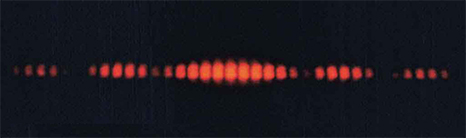
Shown below is the primal role of the interference pattern for a pure wavelength of red low-cal projected onto a double slit. The blueprint is actually a combination of single- and double-slit interference. Note that the bright spots are evenly spaced. Is this a double- or single-slit characteristic? Annotation that some of the bright spots are dim on either side of the center. Is this a single- or double-slit characteristic? Which is smaller, the slit width or the separation between slits? Explicate your responses.
(credit: PASCO)
Problems
Two slits of width  each in an opaque textile, are separated by a center-to-center distance of
  A monochromatic lite of wavelength 450 nm is incident on the double-slit. I finds a combined interference and diffraction pattern on the screen.
(a) How many peaks of the interference will exist observed in the cardinal maximum of the diffraction design?
(b) How many peaks of the interference will exist observed if the slit width is doubled while keeping the distance between the slits aforementioned?
(c) How many peaks of interference will exist observed if the slits are separated by twice the distance, that is,  while keeping the widths of the slits aforementioned?
(d) What will happen in (a) if instead of 450-nm light some other light of wavelength 680 nm is used?
(e) What is the value of the ratio of the intensity of the central superlative to the intensity of the adjacent bright elevation in (a)?
(f) Does this ratio depend on the wavelength of the light?
(one thousand) Does this ratio depend on the width or separation of the slits?
A double slit produces a diffraction design that is a combination of unmarried- and double-slit interference. Notice the ratio of the width of the slits to the separation between them, if the first minimum of the single-slit pattern falls on the fifth maximum of the double-slit blueprint. (This will greatly reduce the intensity of the fifth maximum.)
0.200
For a double-slit configuration where the slit separation is 4 times the slit width, how many interference fringes prevarication in the key elevation of the diffraction design?
Light of wavelength 500 nm falls normally on 50 slits that are  wide and spaced
  apart. How many interference fringes lie in the key peak of the diffraction pattern?
3
A monochromatic light of wavelength 589 nm incident on a double slit with slit width  and unknown separation results in a diffraction pattern containing ix interference peaks inside the primal maximum. Find the separation of the slits.
When a monochromatic light of wavelength 430 nm incident on a double slit of slit separation  there are xi interference fringes in its central maximum. How many interference fringes will be in the central maximum of a calorie-free of wavelength 632.8 nm for the same double slit?
9
Determine the intensities of two interference peaks other than the central peak in the central maximum of the diffraction, if possible, when a light of wavelength 628 nm is incident on a double slit of width 500 nm and separation 1500 nm. Use the intensity of the central spot to exist  .
.
Glossary
- missing guild
- interference maximum that is not seen considering it coincides with a diffraction minimum
- 2-slit diffraction blueprint
- diffraction blueprint of ii slits of width D that are separated by a distance d is the interference design of two indicate sources separated by d multiplied by the diffraction pattern of a slit of width D
mclaughlinherthew.blogspot.com
Source: https://opentextbc.ca/universityphysicsv3openstax/chapter/double-slit-diffraction/
0 Response to "For a Double Slit as the Slit Separation Is Increased What Happens to the Pattern"
Post a Comment